Thermal bed bug remediation provides an absolute physical resolution for persistent infestations where over-the-counter pyrethroid sprays consistently fail due to documented insect resistance. Industrial heat equipment…
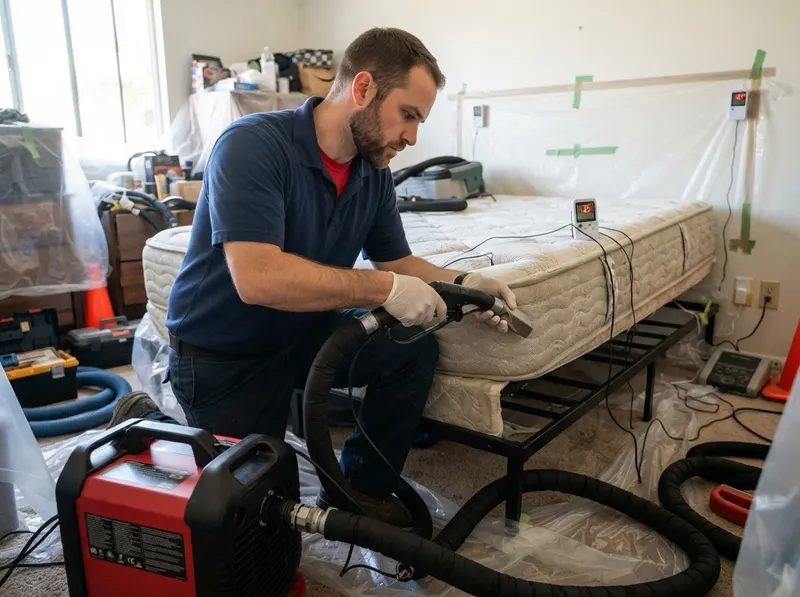
Thermal bed bug remediation provides an absolute physical resolution for persistent infestations where over-the-counter pyrethroid sprays consistently fail due to documented insect resistance. Industrial heat equipment circulates forced convection air to penetrate high-density harborages that liquids cannot touch, including mattress core ticking, subflooring, and structural wall cavities. The protocol elevates the ambient space to lethal thresholds above 122°F, maintaining the temperature soak until structural probe sensors verify thermal transfer through heavy framing timbers and upholstery. Because heat relies on cellular protein denaturation rather than chemical toxicity, the eradication occurs without chemical residues lingering on flooring or furniture, eliminating poison exposure hazards for household pets.
Operational deployment differs strictly by structure and square footage across Los Angeles. In multi-unit properties throughout Echo Park, Silver Lake, and Mid-City, thermal containment prevents active dispersal into neighboring units by deploying high-velocity axial air movers that create uniform heat curtains. Single-family hillside and valley homes in Sherman Oaks, Woodland Hills, and Los Feliz demand higher BTU outputs to overcome larger architectural volumes, plaster heat sinks, and vaulted ceilings. If the objective is complete single-day clearance without discarding expensive bedroom furniture, structural thermal remediation is the operational choice. The clear trade-off is detailed thermal prep work: occupants must remove heat-sensitive items including aerosol cans, fine wax candles, high-end electronics, oil paintings, and prescription medications prior to mobilization.
Execution requires controlled, real-time wireless telemetry. Field operators place secondary thermal sensors behind baseboards and under area rugs in Venice craftsman homes or Brentwood estates to prevent cold spots where bugs could shelter. Step one involves visual canine or technician inspection and mapping of the thermal perimeter. Step two requires sealing HVAC returns, room vents, and exterior door perimeters to secure a pressurized heat bubble. Step three activates high-output heating units that ramp ambient temperatures upward at a controlled 1°F per minute to avoid structural shock. Step four sustains core temperatures at 130°F for a measured window of at least four hours. Step five conducts rapid controlled cooling, returning the home to normal baseline temperatures for immediate, same-day reoccupation.
Every job gets a firm, written price after a free on-site visit.
Tell us about your thermal bed bug remediation job in Los Angeles and we'll send a clear, written quote, usually the same day.
 PestLock Pest Control