Argentine ant supercolonies dominate the subterranean soil profile across Los Angeles County, stretching continuously under residential foundations from coastal sandy loams in Venice to dense clay hillsides in Silver…
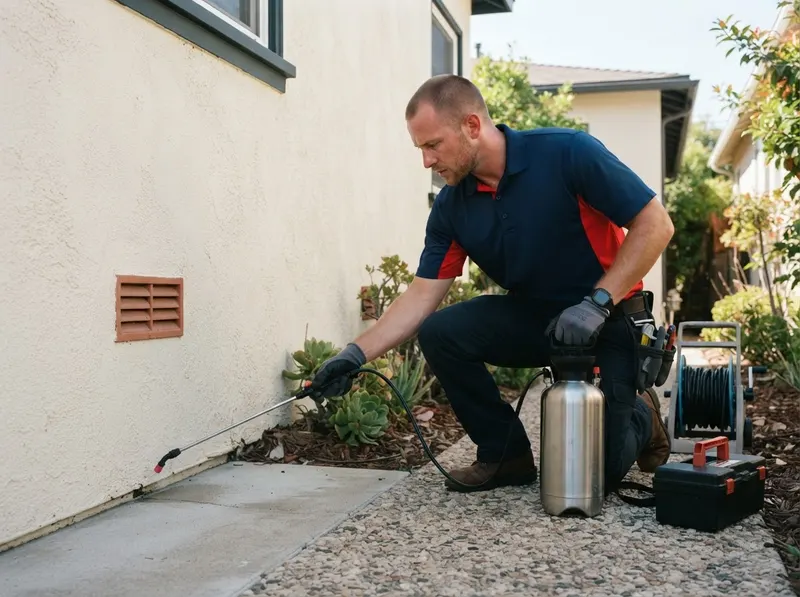
Argentine ant supercolonies dominate the subterranean soil profile across Los Angeles County, stretching continuously under residential foundations from coastal sandy loams in Venice to dense clay hillsides in Silver Lake and Echo Park. During the sustained dry heat of late summer or sudden winter rains, foraging workers follow concrete foundation fissures into kitchens, wall voids, and subfloors. Standard consumer aerosol sprays scatter these colonies into multiple satellite nests through bud-splitting, multiplying the interior trailing points. An exterior perimeter barrier uses a non-repellent formulation such as fipronil, which worker ants cannot detect. The workers travel through the treated zone, transfer the active ingredient back to subterranean queens via social grooming, and eradicate the subterranean brood without distributing synthetic pyrethroids inside interior living spaces.
Properties in foothill microclimates like Los Feliz, Highland Park, and Sherman Oaks experience severe ant intrusions when canopy trees touch rooflines or irrigation lines create damp foundation perimeters. When foliage bridges an exterior wall, workers bypass ground barriers entirely, moving directly through weep screeds, crawlspace vents, or attic fascia boards. Structural exclusion addresses these pathways by trimming back contacting branches to maintain a minimum 12-inch clear zone, sealing perimeter expansion joints with silicone-based caulk, and treating subterranean utility penetrations. In hotter inland areas such as Woodland Hills, the barrier provides structural protection against thermal foraging surges, while in flat urban residential lots in Mid-City and hillside footings in Brentwood, it prevents moisture-seeking trails from breaching raised foundation stem walls.
Choosing an exterior perimeter barrier over whole-house interior spraying avoids chemical residues on kitchen surfaces, baseboards, and pet play areas. The trade-off is mechanical: an exterior barrier requires dry concrete surfaces at application, no rain or automated sprinkler activity for 24 hours, and clear perimeter pathways free of stored wood or dense leaf litter. The mechanical barrier eliminates reliance on perpetual indoor chemical re-treatments, securing the building shell against ant incursions for 60 to 90 days per application.
Every job gets a firm, written price after a free on-site visit.
Tell us about your exterior ant defense perimeter job in Los Angeles and we'll send a clear, written quote, usually the same day.
 PestLock Pest Control